- Home
- YOUR FUTURE
- Futurist Keynotes
- FUTURE EVENTS
- How Patrick Dixon will transform your event as a Futurist speaker
- How world-class Conference Speakers always change lives
- Keynote Speaker: 20 tests before booking ANY keynote speaker
- How to Deliver World Class Virtual Events and Keynotes
- 50 reasons for Patrick Dixon to give a Futurist Keynote at your event
- Futurist Keynote Speaker - what is a Futurist? How do they work?
- Keys to Accurate Forecasting - Futurist Keynote Speaker with 25 year track record
- Reserve / protect date for your event / keynote booking today
- Technical setup for Futurist Keynotes / Lectures / Your Event
- Dr Patrick Dixon MBE
- Futurist Books
- 18 books by Futurist P Dixon
- How AI Will Change Your Life
- The Future of Almost Everything
- SustainAgility - Green Tech
- Building a Better Business
- Futurewise - Futurist MegaTrends
- Genetic Revolution - BioTech
- The Truth about Westminster
- The Truth about Drugs
- The Truth about AIDS
- Island of Bolay - BioTech novel
- The Rising Price of Love
- Clients
- CONTACT for KEYNOTES

Patrick Dixon - Futurist Keynote Speaker "How AI Will Change Your Life" - 18th book
25 Years Experience in Future Trends Forecasting >400 Global Clients - Every Industry and Region
Truth about AI and Sustainability - huge positive impact of AI on ESG UN goals, but energy consumed
AI will help a sustainable future - despite massive energy and water consumption. AI Keynote speaker
The TRUTH about AI. How AI will change your life - new AI book, beyond all the hype. Practical Guide
How AI Will Change Your Life: author, AI keynote speaker Patrick Dixon, Heathrow Airport WH Smiths
How AI will change your life - a Futurist's Guide to a Super-Smart World - Patrick Dixon is a Global Keynote Speaker on AI, Author of 18 BOOKS, Europe's Leading Futurist with 25 year track record advising large multinationals - CALL NOW +44 7768 511390
How AI Will Change Your Life - A Futurist's Guide to a Super-Smart World - Patrick Dixon signs books and talks about key messages - future of AI, how AI will change us all, how to respond to AI in business, personal life, government. CALL +44 7768 511390
Future of Sales and Marketing in 2030: physical audience of 800 + 300 virtual at hybrid event. Digital marketing / AI, location marketing. How to create MAGIC in new marketing campaigns. Future of Marketing Keynote Speaker
TRUST is the most important thing you sell. Even more TRUE for every business because of AI. How to BUILD TRUST, win market share, retain contracts, gain customers. Future logistics and supply chain management. Futurist Keynote Speaker
Future of Artificial intelligence - discussion on AI opportunities and Artificial Intelligence threats. From AI predictions to Artificial Intelligence control of our world. What is the risk of AI destroying our world? Truth about Artificial Intelligence
How to make virtual keynotes more real and engaging - how I appeared as an "avatar" on stage when I broke my ankle and could not fly to give opening keynote on innovation in aviation for. ZAL event in Hamburg
"I'm doing a new book" - 60 seconds to make you smile. Most people care about making a difference, achieving great things, in a great team but are not interested in growth targets. Over 270,000 views of full leadership keynote for over 4000 executives
Futurist Keynote Speakers - how Futurist Keynotes transform events, change thinking, enlarge vision, sharpen strategic thinking, identify opportunities and risks. Patrick Dixon is one of the world's best known Futurist Keynote Speaker
Futurist Keynote Speaker: Colonies on Mars, space travel and how digital / Artificial Intelligence / AI will help us live decades longer - comment before Futurist keynote for 1400 at Avnet Silica event. Futurist Keynote Speaker on AI
Future of Travel and Tourism post COVID. Boom for live experiences beyond AI. What hunger for "experience" means for future aviation, airlines, hotels, restaurants, concerts halls, trends in leisure events, theme parks. Travel Industry Keynote Speaker
Quiet Quitters: 50% US workforce wish they were working elsewhere. How engage Quiet Quitters and transform to highly engaged team members. Why AI / Artificial Intelligence is not answer. How to tackle the Great Resignation. Human Resources Keynote Speaker
The Great Resignation. 50% of US workers are Quiet Quitters. They have left in their hearts, don't believe any longer in your strategy. 40% want to leave in 12 months. Connect with PURPOSE to win Quiet Quitters. Human Resources Keynote Speaker
Future of Human Resources. Virtual working, motivating hybrid teams, management, future of motivation and career development. How to develop high performance teams. HR Keynote Speaker
Speed of change often slower than people expect! I have successfully forecast major trends for global companies for over 25 years. Focus on factors driving long term changes, with agile strategies for inevitable disruptive events. Futurist Keynote Speaker
Agile leadership for Better Risk Management. Inflation spike in 2022-3 - what next? Expect more disruptive events, while megatrends will continue relentlessly to shape longer term future globally in relatively predictable ways. Futurist Keynote Speaker
Crazy customers! Changing customer expectations. Why many decisions are irrational. Amusing stories. Lessons for Leadership, Management and Marketing - Futurist Keynote Speaker VIDEO
Deflation - the real risks to global economy and future of banking - ARCHIVE 2010 - very accurate forecastin. Futurist Keynote Speaker - global economy
Futurist Keynote Speaker: Posts, Slides, Videos - Banks, Banking, Insurance, Fund Management
Video recorded in April 2010 but the issues remained very relevant in 2013 (despite some warnings of inflation heading into 2014)

Hong Kong Composite Consumer Price Index - Source: HK government
Future of Banking: At the 2003 World Economic Forum meetings in Davos there was much talk about the possibilities of deflation: a real and growing threat to a number of economies, despite the fact that most governments have been obsessed with reducing inflation. Indeed entire government economic policy has often been focussed on just one main factor: killing inflation. Why?
Soaring inflation rates have been blamed for many national crises and even for causing wars. Time and again we have seen countries with out-of-control cost of living rises: strikes, industrial action and high wage demands all feeding into higher production costs, encouraging a spiral of further upward pressures on consumer prices. Inflation is often blamed for destroying the value of savings, and making people poor. But collapsing prices also creates a crisis - as we see in cycles of boom, bustle and bust.
Need a world-class keynote speaker on the global economy or banking? Phone Patrick Dixon now or email.
The US was deflating in 40% of goods and services
But the reality in 2002 was deflation across many industry sectors. Take the US economy. Prices for 40 percent of all the goods and services in the Labor Department's consumer price index (CPI) showed year-over-year declines in September 2002, according to research by Merrill Lynch's chief Canadian economist David Rosenberg. Corporations in the deflating sectors below form 25% of the stocks in Standard and Poor's 500 index.
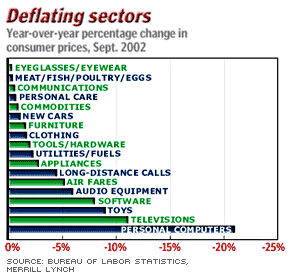
Some think governments are being too slow to recognise the great dangers of low inflation, where a single economic blow can push an entire nation over the edge into deflation, with falling cash values of every asset and every investment.
Deflation means a complete mental rethink and is beyond the understanding of most people today who were raised in inflationary times. The real question is an emotional one: how will ordinary people behave if they think prices are going to fall year on year for more than a very short period?
And how will investors in the market behave? As we saw in Japan (1990s), if they start pricing in an expectation of deflation across most sectors, rather than just 40% in some sectors, it will have a significant effect on valuations and reduce appetite even more for buying stocks.

Consumers often rely on inflation to help them repay debts - particularly house loans. Inflation of 5% means a mortgage is only half what it was in real terms in 15 years.
What happens in deflation?
When prices fall, the value of cash rises. Anyone with money has an advantage and those with debts lose. If I have a mortgage of $250,000 this year, and deflation runs at 5% a year, it means in real terms my loan will double in size over 15 years. Most worryingly, in deflation, my loan (which was only 70% of the value of my home) will become so huge that even if I sell my home, I will be left with large debts.
We have all seen deflation before in one key area: computers and digital technology where deflation has been eating away at price levels for three decades or more. But this is different. It is one thing to write off an investment in a computer system over three years, but another to find that one of your greatest assets, your own home, is worth only a small fraction of what it was twenty years ago, and that prices of every other asset you own are also expected to go on falling.
Of course if you have cash in hand, the temptation is to spend nothing, and invest in nothing. What is the point of buying when you know that in six months time the chances are you could buy more? So money gets left as cash under the bed, or in a bank account (if you are prepared to risk the bank going bust because so many loans were secured against assets, now worth almost nothing). Spending falls, feeding a further frenzy of price cutting, downward pressure on salaries, bonus cutting, and so on. But it is easier to pay people less and get away with it when they know they need less to live on this year than last year.
Interest rates fall to zero, because no one in their right minds wants to borrow large amounts of an asset (cash) which is going to inflate with time. Indeed the only asset for ordinary men and women that grows in value in a deflationary economy is cash, and cash is what you find they hang on to. Just look at Japan which has experienced deflation for years with terrible consequences.
How serious is the risk of deflation hitting other economies?
What happens when interest rates fall to zero
The main tool that governments use to control inflation is interest rates, but this tool can lose its power if rates are already so low that there is hardly any room left to cut further before the cost of borrowing falls to zero. Another terrorist shock, a war in Iraq that goes badly wrong, or some other national calamity... it is not hard to imagine a scenario where further rate cuts become necessary.
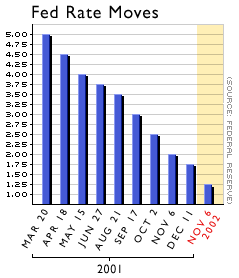
Think about it from the ordinary man or woman in the street's point of view. If interest rates are zero, I can go out and get a huge loan and it costs me nothing at all. Of course the loan must one day be repaid, but when? The bank soon realises I am over extended and cannot repay, but is in no hurry because the loan repayments will be worth more to them in the future, if they give me longer to find the money. They are not losing a penny in interest because the interest rate is zero. In fact every day the bank waits, the more they make, because the price of money is rising as the price of everything else falls - that is the reality of deflation.
Old economics relied on inflation running at a safe modest level - not too high and not too low. It taught us that raising the cost of borrowing also raises the returns to savers, and sucks money out of the economy so less is around to be spent by consumers, goods hang around before being sold and market prices are constrained. Lowering interest rates encourages people to spend without worrying, more cash chases goods for sale, prices rise.
Unfortunately there are a number of drivers of deflation, so it will be easy for governments to find rates lower turn out lower than they expected. That's why banks try to keep a margin for error and will take radical steps to prevent inflation falling from - say - an absolute minimum of 2.5% or even 3% a year.
Deflation Drivers
1. Globalization: every time a job moves from a high income country to a low income country, the price of production falls, and the potential for price cutting increases, while maintaining profits and market share. We are currently witnessing rapid and accelerating changes in industry and services. Even less developed countries like Mexico are finding large chunks of their manufacturing capacity moving to places such as China. India is taking a significant share of software development, with entire teams being made redundant in the UK and the US, replaced by teams twice the size at a fraction of the cost in places like Hyderabad and Bangalore. And as prices rise in places like coastal China, jobs will shift to other less developed regions.
2. Technology innovation: every time a new production process is developed, using less people and less resources, prices fall. In the past, technology purchases formed only a small part of our lives, but the techno-economy continues to grow dramatically, despite the hype and gloom of investors. And the indirect spin-offs are becoming greater every day. Take for example food technology and processing, where new automated packaging and distribution systems have contributed to falling food prices for over a decade, or new farming methods with increased yields, or the impact of online business to business relationships and just-in-time delivery systems.
3. Economic cycles and global shocks. Every economy goes through ups and downs and events outside any government's control also have impact. Take for example major terror attacks or turmoils in the Middle East affecting oil prices, which have recently fluctuated widely and may continue to do so. When oil prices rise, there is inflationary pressure. Governments respond by factoring this into decisions to raise interest rates and inflation falls towards a base level. But if that minimum is too low, what happens if there is another major downwards correction and for a while oil prices fall very significantly? The answer is an added risk of undershooting and causing deflation.
Acting to prevent further deflation
So then, as we have seen, sectors in many economies are already deflating. What can governments do of they are worried about deflation, or to correct national deflation once it starts?
Firstly they can cut interest rates more aggressively while they are still able.
Secondly they can suspend or revoke tax rises for a limited period. Thirdly they can increase expenditure. Both these options of course affect government debt and are sustainable only in the short term without profound consequencies.
In summary then, both inflation and deflation pressures can worry governments, with potential risks to stability in countries where inflation has been allowed to fall too low. Governments should be expected to act from time to time, aiming to maintain around 2.5% to 3.0% inflation throughout economic cycles, giving room for adjustments and economic shocks in both directions.
Need a world-class keynote speaker on the global economy or banking? Phone Patrick Dixon now or email.
| < Prev | Next > |
|---|
Newer news items:
- Future of Fund Management and Banking - Keynote Speaker
- Future of Stock Exchanges and Investment why local trading communities survive. Financial Services Keynote Speaker
- Future of Fund Management: banks, pensions, trust, banking crisis and investment performance
- Listing on Stock Exchange blessing or curse? Future investment and banking trends
- Mobile payments threaten retail banks / credit cards
- Spam and fraud threat to future of banking. FUTURIST Q&A Patrick Dixon
- Zopa Loans - Boom in Peer to Peer Lending - Future of Banking Keynote Speaker
- When will banking profits recover? Keynote speaker on Future of Banking
- Future of Banking, Bank trends, AI, FinTech, Fund Management, Cryptocurrencies
- How to lose $ millions - video on risk. Future of Banking Keynote Speaker
- Future of Banking: How to lose millions - dangers from "unique" business offers. Business risks and scandals. Lessons from collapse of Icelandic Banks
- Future of Banking - Credit Crunch - Banking Trends - Futurist Keynote Speaker
- Credit Crunch and Sub-Prime Crisis - 2008 Video on Future of Banking - turned out to be very perceptive. Future of Banking Keynote Speaker
- What next in the Sub-Prime Crisis? - Video on Future of Banking / Economy
- Future of Banking: New Technology impact on Corporate Banking - 25 year track record of accurate forecasting of banking megatrends by Futurist Keynote Speaker Patrick Dixon
Older news items:
- Future of Banking - Web TV - ARCHIVE 1997
- Future of Banking - EU Online Banking - ARCHIVE 1997
- Future of Banking: Online Banking outside US / EU - ARCHIVE 2007
- Future of Banking - US Online Banking - ARCHIVE 1997
- Future of Banking: Online Banking Competitors - ARCHIVE 1997
- Future of Banking: Online Threat to Banks - ARCHIVE 1997
- Future of Banking: Growing demand for cyberbanking in EU
- Future of Banking: Digital Meltdown of Financial Services - Video - Archive 1998
- Future of Banking: Merger fever in EU - ARCHIVE 1998
- Future of Banking - ARCHIVE 2002 - Futurist banking keynote speaker
- Web TV - future of banking and financial services
- Future of Investment Banking - End of "Old" Stock Exchanges
- The Death of Stock Exchanges - feature on Future of Stock Exchanges and Trading Platforms for Time Magazine - by Futurist Keynote Speaker Patrick Dixon
- Future of Banking and Financial Services
Thanks for promoting with Facebook LIKE or Tweet. Really interested to read your views. Post below.
Futurist Keynote Speaker - New
- How to give world-class presentations. Keys to great keynotes. How to communicate better and win audiences over. Expert coaching for CEOs, Executives, keynote speakers – via Zoom or face to face
- Future of the Auto Industry: Why Our World Needs Low Cost Chinese e-vehicles. Impact of China electric cars on US and EU auto industry. Sustainability and GreenTech innovation keynote speaker
- Daily Telegraph:"If you need to acquire instant AI mastery in time for your next board meeting, Dixon’s your man. Over two dozen chapters. Business types will enjoy Dixon's meticulous lists and his willingness to argue both sides." BUY AI BOOK NOW
- Interview: How AI Will Change Your Life - book author Patrick Dixon, keynote speaker on AI, in conversation with Alison Jones, Extraordinary Business Book Club. Looking for a keynote speaker on AI? BOOK AI Keynote NOW
- Impact of AI on $10tn PA food and beverage sales (F&B), fast moving consumer goods (FMCG). Why trust and emotion matter in an AI-influenced retail world. Extract Ch 16 - new book: How AI will Change Your Life - Patrick Dixon Futurist Keynote Speaker
- AI in Government. Impact of AI on state departments, AI efficiency, AI cost-saving. AI policy decisions and global regulation of AI. Extract from Chapter 26 - new book: How AI will Change Your Life - by Patrick Dixon, keynote speaker on insurance and AI
- AI warfare: AI in future conflicts. Battlefield AI, impact of AI on defence, military budgets, AI hybrid weapons, armed forces strategy. Extract from Ch25 - new book: How AI will Change Your Life - by Patrick Dixon, keynote speaker on Defence and AI
- AI will create HUGE new cybersecurity risks, hijacked by criminals and rogue states. Paralysis of companies, hospitals, governments. Extract from Chapter 23 - new book: How AI will Change Your Life - Patrick Dixon, keynote speaker - cybersecurity and AI
- AI for Insurance: how AI will impact AI in underwriting, quotes, re-insurance. AI will improve claims handling, AI reducing fraud. Extract from Chapter 22 - new book: How AI will Change Your Life - by Patrick Dixon, keynote speaker on insurance and AI
- How AI will impact banks: AI will save bank core costs, deliver better banking services, but AI will also create huge new banking risks. Extract from Chapter 22 - new book: How AI will Change Your Life - by Patrick Dixon, keynote speaker on banking and AI
- AI Investing, AI in Fund Management, Pension Funds, AI trading in Stock Markets and Global Financial Services AI, Banking AI. Extract from Chapter 21 - new book: How AI will Change Your Life - by Patrick Dixon, keynote speaker on Fund Management AI
- How AI will double digital energy consumption globally in 10 years. AI will have huge impact on energy, environment, sustainability. Extract from Chapter 20 - new book: How AI will Change Your Life - by Patrick Dixon, keynote speaker on sustainable AI
- AI in Construction - future Impact of AI on built environment. Buildings design, architecture, site development, AI in smart cities. Extract from Chapter 19 - new book: How AI will Change Your Life - by Patrick Dixon, keynote speaker on AI in construction
- Manufacturing AI. How AI will transform factories and manufacturing, including AI logistics and AI-driven supply chain management. Extract from Chapter 18 - new book: How AI will Change Your Life - by Patrick Dixon, keynote speaker on AI in manufacturing
- AI impact on travel, tourism AI, transport AI, auto industry AI, aviation AI, airlines. How AI will change the travel experience.Extract from Chapter 14 - new book: How AI will Change Your Life - by Patrick Dixon, keynote speaker on AI for travel industry
- Future of retail AI: impact on retail sales, retail marketing, customer choice, AI predicts demand, AI warehouse, AI supply chains.Extract from Chapter 13 - new book: How AI will Change Your Life - by Patrick Dixon, keynote speaker on AI retail trends
- Future Marketing: Impact of AI on Marketing - how AI will transform marketing, AI trends in advertising. Extract from Chapter 12 - new book: How AI will Change Your Life - by Patrick Dixon, keynote speaker on AI marketing
- Impact of AI on search engines, what AI means for news sites, AI in social media, AI in publishing and AI art copyright. Extract from Chapter 11 - new book: How AI will Change Your Life - by Patrick Dixon, AI keynote speaker
- Future of Music Industry: AI impact on music, musicians, record labels, AI composing, AI lyrics, AI copyright violations. AI for song-writers, singers, album producers.Extract book Ch10: How AI will change your life - Patrick Dixon Keynote Speaker
- Future Film, TV, Media, video games - impact of AI on film-making, AI movies, AI in studios, post-production AI, computer games. Extract from Ch10 new book: How AI will Change Your Life - by Patrick Dixon, AI keynote speaker on film industry, TV and media
- Impact of AI on software development, programming, high level coding, AI system design, and AI strategy. Extract from Chapter 9 - new book: How AI will Change Your Life - by Patrick Dixon, AI keynote speaker on software and IT strategy / design
- Impact of AI on adult education. Teaching entire nations how to tell what is true v fake news, AI scams or false consipiracy theories. Extract from Chapter 9 - new book: How AI will Change Your Life - by Patrick Dixon, AI keynote speaker on education
- Future of Education - Impact of AI on Teaching, Schools and Colleges. Why AI will force radical changes in teaching curriculum and methods. Extract from Chapter 7 - new book: How AI will Change Your Life - by Patrick Dixon, AI keynote speaker on education
- Impact of AI on Pharma, Drug Discovery, Drug Development and Clinical Trials.10m lives Will Be Saved A Year Globally Because Of AI In Pharma and Health. Extract Ch 6 New Book: How AI Will Change Your Life - Dr Patrick Dixon, Pharma And AI Keynote Speaker
- How health care, hospitals and community care will be impacted by AI. 10 million lives will be saved a year globally because of AI in health. Extract from Chapter 5 - new book: How AI will Change Your Life - Dr Patrick Dixon, health and AI keynote speaker
- How will AI impact office workers, teams and working from home (WFH)? Lessons for every team leader, manager and leader on AI impact at work. Extract from Chapter 4 - new book: How AI will Change Your Life - by Patrick Dixon, AI keynote speaker
- Why AI will result in MORE JOBS. Myth of global job destruction from AI due to net job creation. How will AI impact the workplace and work itself? Extract from Chapter 3 - new book: How AI will Change Your Life - by Patrick Dixon, AI keynote speaker
- Super-Smart AI and a Reality Check. How Super-smart AI will become conscious, posing all kinds of new Super AI / AGI risks to future of humanity. Extract From Chapter 2 - New Book: How AI Will Change Your Life - by Patrick Dixon, AI keynote speaker
- The TRUTH about AI / Artificial Intelligence. What is REALLY happening and why this matters now for your personal life, job and wider world. Extract from Chapter 1 - new book: How AI will Change Your Life - by Patrick Dixon, AI keynote speaker
- Impact of AI on Health Care and Pharma – Artificial intelligence keynote outline for Pharma companies and health care organisations. How will AI drive future AI innovation in health and Pharma?
- How AI will change your life - my latest book, out NOW A Futurist's guide to a super-smart world. 28 chapters on impact of AI in industry, government, company, personal lives. Patrick Dixon is a world leading keynote speaker on AI. CALL +44 7768511390
- Risk of Russia war with NATO. Russia's past is key to it's military future. War and Russian economy, Russian foreign policy and political aspirations, future relationship between Russia, China, EU, NATO and America - geopolitical risks keynote speaker
- Over 2 million have watched my Green Energy Webinar! "Next 20 years will determine future of humanity": predictions for 40 years. Massive scaling green tech. Race for solar, wind v coal, oil, gas. Climate emergency. Futurist Keynote for Enel Green Power
- How AI / Artificial Intelligence will transform every industry and nation - banking, insurance, retail, manufacturing, travel and leisure, health care, marketing and so on - What AI thinks about the future of AI? Threats from AI? Keynote speaker
- The Future of AI keynote speaker. Will AI destroy the world? Truth about AI risks and benefits. (Some of this AI post written by AI ChatGPT - does it matter?). Impact of AI on security, privacy AI, defence AI, government AI - keynote speaker
- Future of Rail in 2030: trends in rail passengers, rail freight, railway innovation. High speed rail, impact on aviation. Rail logistics and supply chain management. AI impact, Zero carbon hydrogen powered railway locomotives - Rail Trends Keynote
- Future of the Auto Industry 2040. Trends impacting the auto industry, car manufacturers, truck factories. Auto industry innovation, autonomous vehicles, flying cars, vehicle ownership, car insurance AI / Artificial Intelligence.Futurist Keynote for Belron
- Future of Aviation: Carbon Zero Planes. New fuels such as hydrogen, smaller short distance battery powered vertical take-off vehicles. Why Sustainable Aviation Fuel is not the answer to global warming. 100s of innovations such as AI will impact aviation
- THE TRUTH ABOUT FUTURE MASS MIGRATION - a people movement with greater force than any military superpower. As I predicted in "Futurewise" (1998-2005), large scale migration is now unstoppable, able to break governments, yet many nations NEED migration
- Why MOST CEO SPEECHES don't create passion or purpose - just create Quiet Quitters. 270,000 views of this PURPOSE speech which no AI can deliver. For typical company in an industry often criticised. Reverse Great Resignation! Leadership Keynote Speaker
- The Future of Life Insurance. Why life insurance will boom globally. New pattens for selling life cover, AI automated underwriting , wearable devices, dynamic premiums. How life expectancy will change.How to build your brand.Life Insurance keynote speaker
- Future of Leadership and Management, Human Resources, Virtual Teams and AI, Hybrid Working, Offices, Quiet Quitting, Careers, Team Motivation, Attracting Talent, Team Engagement - Workplace Keynote Speaker
- Back to Work! Face to Face Meetings Win New Business, Accelerate Innovation, Increase Agility, Implement Change. Future Offices, Future of Work and Workplace in world of AI. Working from Home (WFH). Artificial Intelligence impact on Work
- Future of Retail Globally - why scale matters for lower cost, better products, stronger brand. Future retail growth in every region of the world will follow same patterns. 70% of retail is 8 companies in the UK. Retail Keynote Speaker
- Queen Elizabeth II: the power of example over a lifetime. Lessons for all great leaders. Why her impact on our future world will be so long lasting. Example is the only form of leadership that endures, because it is based on integrity and authenticity
Most Read - Futurist Speaker
- Futurist Speakers: How keynote by Patrick Dixon will transform your event. Visionary, high impact, high energy, entertaining Futurist keynotes on future trends. Keynotes on AI, tech, health, marketing, manufacturing etc. 370,000 reads. CALL +44 7768511390
- Conference Speakers: How Great Conference Speakers Change Lives. 10 tests BEFORE booking top conference speakers. Keys to world-class events. Secrets of ALL best keynote speakers. Who are best keynote speakers in world? 327,000 reads. CALL +44 7768511390
- Future of Marketing 2030 - Marketing Videos, key marketing trends and impact of AI on marketing campaigns. Conference Keynote Speaker on Marketing - 234,000 have read this post. Marketing Keynote Speaker: CALL NOW +44 7768 511390
- The Future of Outsourcing in world beyond AI - Impact on Jobs - Futurist keynote speaker on opportunities and risks from outsourcing / offshoring. Why many jobs coming home (reshoring - shorter supply chains). AI and new risk, higher agility. 200000 views
- Future of Stem Cell Research - Creating New organs and repairing old ones. Trends in Regenerative Medicine, anti-ageing research, AI. Future pharma, clinical trials, medical research, heath care trends, and biotech innovation.Health care keynote speaker
- Future of the European Union - Enlarged or Broken? What direction for the EU over the next two decades? Geopolitics keynote speaker
- The Truth About Drugs - free book by Dr Patrick Dixon - research on drug dependency, addiction and impact on society of illegal drugs
- 10 trends that will really DOMINATE our future - all predictable, changing slowly with huge future impact - based on book The Future of Almost Everything by world-renowned Futurist keynote speaker. Over 100,000 views of this post. Discover your future!
- Forecasts I made re Brexit were correct: short term and long term. Impact on your personal life, house prices, brexit business strategy, community, EU and wider world. Cut through toxic nonsense. Keynote speaker on geopolitics and economy
- Future of the Automotive Industry (Auto Trends) - e-cars, lorries, trucks and road transport trends, reducing CO2 emissions, e-cars, eVTOL flying vehicles, hydrogen, autonomous AI drivers, auto industry impact from AI. Futurist keynote speaker
- Marketing to Older Consumers - 1.4 billion over 60 year old consumers by 2030. Future of Marketing Keynote Speaker. Ageing customers, strategies to target older consumers and other marketing trends. Why many companies fail in marketing to older people
- Future of Aviation Industry. Rapid bounce back after COVID AS I PREDICTED. Most airlines and airports were unprepared for recovery. Aviation keynote Speaker. Fuel efficiency, reducing CO2, hydrogen fuel, AI, zero carbon, flying taxis (eVTOL)
- China as world's dominant superpower - Impact on America, Russia and EU. Futurist keynote speaker on global economy, emerging markets, geopolitics and major market trends
- Web Traffic: Up to 2.9 million pages a month - Future Trends website of Patrick Dixon, Futurist Keynote Speaker
- The Truth About Westminster
- Futurist Keynote Speakers. 20 secrets of world's best keynote speakers. How to select great keynote speakers for your events. Secrets of all top keynote speakers. Change how people see, think, feel and behave. Who are the best? CALL +44 77678 511390
- The Truth about AIDS
- Future of Insurance 2030. Insurance industry trends keynote speaker. How insurance customers are changing. Why insurance marketing, AI underwriting and claims handling will change radically. Most important growth markets for insurance products
- Patrick Dixon Futurist Keynote Speaker - ranked one of top 20 most influential business thinkers, Chairman Global Change Ltd, Author 18 Futurist books. Call now to discuss a Transformational Futurist Keynote for Your Event: +44 7768 511390
- Total media audience >450 million on TV, Radio, Press Coverage of Patrick Dixon, Futurist Keynote Speaker - Call Patrick Dixon NOW for media interviews (or for event keynotes) on +44 7768 511390.